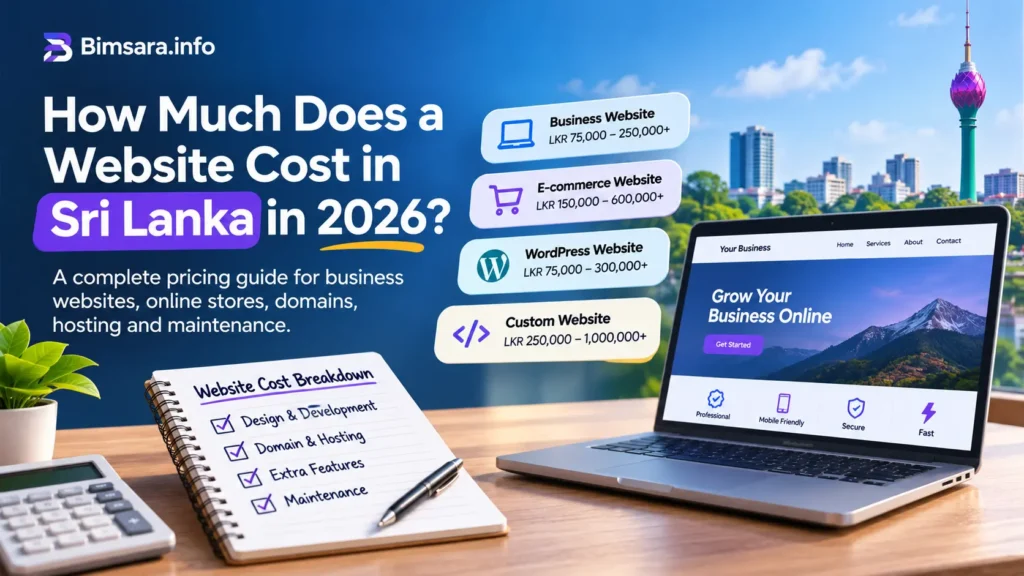
Planning a new website for your business in Sri Lanka? One of the first questions is how much it will cost. The answer depends on what the website needs to do, who builds it, and what is included after launch. This guide breaks down realistic budgeting considerations for 2026 without pretending that every project has a fixed price.
Website Cost in Sri Lanka: Quick Budget Overview
As a starting point for planning—not verified market averages or fixed quotations—consider these illustrative budgets in Sri Lankan rupees (LKR):
A simple one-page landing page: approximately LKR 25,000–70,000. A small informational business website: approximately LKR 60,000–180,000. A more customized business website: approximately LKR 150,000–400,000+. A small WooCommerce online store: approximately LKR 120,000–350,000+. Complex e-commerce or custom web applications may cost substantially more.
These ranges are rough budgeting examples, not surveyed Sri Lankan vendor prices. Actual proposals can fall outside them depending on scope, design, integrations, content, and ongoing support. Request an itemized quote before committing.
1. What Type of Website Do You Need?
One-Page Landing Page
A landing page focuses on one goal: generating inquiries, promoting a service, or collecting leads. It typically includes a headline, benefits, testimonials, a contact form, and a clear call to action. Costs rise when copywriting, custom illustrations, tracking, or integrations are needed.
Small Business Website
A typical small business website may include Home, About, Services, Portfolio, Blog, and Contact pages. The scope should specify mobile responsiveness, basic on-page SEO, contact forms, analytics setup, and whether the client supplies text and images. Read our guide to the essential features every small business website needs: https://trusty-darkslateblue-wasp-53.hostingersite.com/small-business-website-design-essentials/.
E-commerce Website
An online store needs more than attractive product pages. It may require product variations, inventory management, delivery rules, payment integration, order notifications, security, and staff training. The number of products and complexity of checkout often matter more than the number of pages. For platform selection, see our WooCommerce vs Shopify comparison: https://trusty-darkslateblue-wasp-53.hostingersite.com/woocommerce-vs-shopify-2026/.
Custom Website or Web Application
Booking systems, customer portals, membership platforms, dashboards, and integrations with external software need discovery and technical planning. These projects should be estimated against written requirements and milestones rather than a generic per-page rate.
2. What Makes Website Prices Go Up or Down?
Design approach: a carefully configured template is usually faster to deliver than a bespoke interface. Content: professional copywriting, translation, photography, and product data entry take time. Functionality: bookings, online payments, multilingual pages, and CRM connections increase scope. Revisions: a clear number of design rounds prevents misunderstandings. Quality assurance: mobile testing, accessibility checks, performance work, and cross-browser testing require effort but protect the final result.
A low initial quote can become expensive if essential features are excluded. Ask every provider to distinguish included work from optional extras.
3. WordPress vs Custom Development
WordPress is often a practical choice for service businesses, portfolios, blogs, and many online stores because content can be updated through a familiar dashboard. A custom-coded solution may be appropriate when the product needs unusual workflows, specialized integrations, or stringent performance requirements. Neither option is automatically better: choose based on business needs, ownership, maintainability, and total lifetime cost.
For a WordPress project, clarify which themes and plugins are licensed, whether premium subscriptions renew annually, and who is responsible for updates and backups.
4. Domain, Hosting, and Ongoing Expenses
The development quote is only part of the budget. A domain name normally renews annually; its cost depends on the extension and registrar. Hosting may be billed monthly or yearly and varies with storage, traffic, server resources, backups, and support. Premium themes, plugins, email services, security tools, and payment gateway fees can add recurring expenses.
For planning purposes, a small website might reserve roughly LKR 15,000–60,000+ per year for basic domain and hosting services, but this is an illustrative allowance, not a current provider quotation. Higher-traffic stores and managed infrastructure may cost much more. Ask for the exact renewal prices, currency, taxes, and billing owner.
5. Hidden Costs to Ask About Before You Sign
Check whether the proposal covers SSL setup, mobile testing, basic search-engine indexing, redirects from an old site, image optimization, legal-policy pages, training, analytics, spam protection, backups, and post-launch bug fixes. For an online store, ask who configures shipping, taxes, payment verification, and transactional emails.
Also confirm who owns the domain, hosting account, website files, design assets, and administrator access. A professional handover should leave your business able to manage its digital assets.
6. How Long Does It Take to Build a Website?
A focused landing page may take days to a couple of weeks once content is ready. A typical small business website may take several weeks, while a customized store or web application can take longer. These are indicative timelines, not delivery guarantees. Delayed content, feedback, payment gateway approvals, and scope changes can affect launch dates.
7. How to Compare Website Development Quotes
Send the same brief to each provider: business goals, required pages, examples of websites you like, essential features, languages, content responsibilities, deadline, and budget range. Compare the deliverables rather than only the headline price.
A useful quote should state the project scope, milestones, payment schedule, revision limits, third-party charges, testing process, training, ownership, warranty or support period, and maintenance options. Ask what happens when new requirements appear during development.
8. How to Keep Your Website Budget Under Control
Start with a minimum viable website that supports the most important customer journey. Prioritize clear messaging, fast mobile pages, trustworthy contact information, and a straightforward inquiry or checkout process. Defer optional animations and complex integrations until there is a business reason to add them.
Avoid common e-commerce design mistakes that can hurt sales: https://trusty-darkslateblue-wasp-53.hostingersite.com/ecommerce-website-design-mistakes/. Once the site is live, measure inquiries, sales, and visitor behavior so future improvements are guided by evidence.
Frequently Asked Questions
Can I build a business website for under LKR 50,000?
It may be possible for a tightly scoped landing page or template-based project, especially when you provide ready-to-use content. Confirm exactly what is included and whether hosting, domain, and maintenance are separate.
Is WordPress free?
WordPress software is open source, but building and operating a professional website can involve development, hosting, domain registration, premium tools, maintenance, and content costs.
Does an e-commerce website cost more than a regular website?
Often yes, because payments, product management, order processing, security, and shipping introduce additional setup and testing. The final cost depends on store complexity.
Do I need to pay every year?
Usually some ongoing costs remain, such as domain renewal, hosting, and any paid licenses or support plans. Ask your provider for a separate annual cost estimate.
Get a Website Quote for Your Business
The right website budget depends on your goals, not just the number of pages. If you are planning a business website, redesign, or online store in Sri Lanka, contact Bimsara.info with a short project brief. Ask for a tailored, itemized quotation that explains the scope, timeline, and ongoing costs before development begins.
Final note: All LKR ranges above are illustrative planning estimates, not verified 2026 market-price data or a binding offer. Prices and service availability should be confirmed directly with providers.