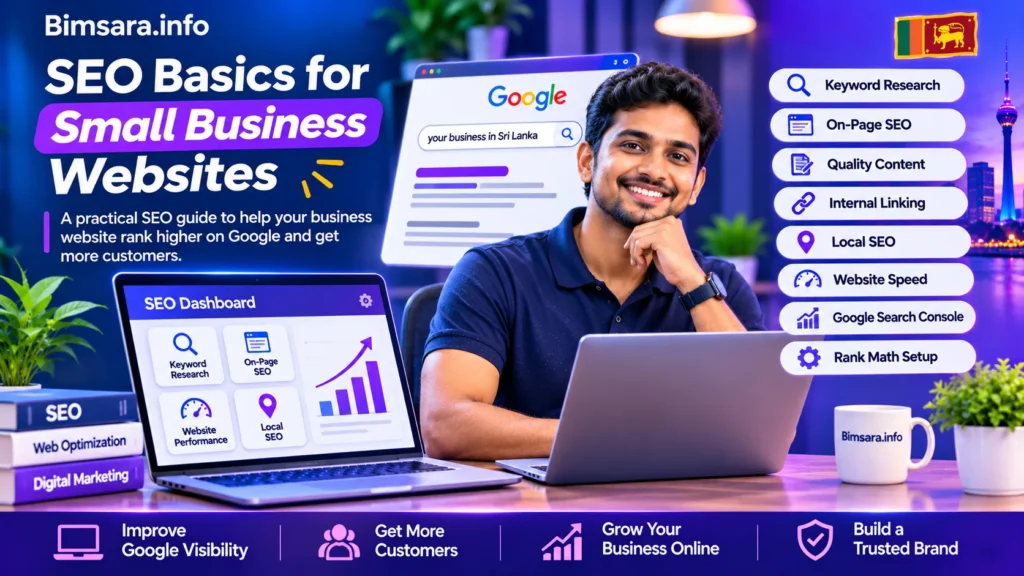
Understanding SEO basics for small business websites can help you reach customers who are already looking for your products or services. Whether you operate a local shop in Sri Lanka, a professional service business or an online store, you do not need to master every technical detail to start improving your search visibility.
Search engine optimization (SEO) means improving how search engines discover and interpret your pages while making those pages more useful to visitors. It is a long-term process, not a shortcut to guaranteed rankings. This guide draws on Google’s official Search Central documentation, reviewed on November 18, 2026, and translates the principles into practical steps for business owners.
1. Understand how Google discovers your website
Google first discovers URLs, often by following links. It may then crawl a page, process its content and consider it for inclusion in its index. Search results are selected according to the query and many other signals. Publishing a website or submitting a sitemap does not guarantee that every page will be indexed or ranked.
Start by checking that your important pages are publicly accessible, return successful HTTP responses and are not accidentally marked noindex. Use the Google SEO Starter Guide to understand the fundamentals. If you are still planning your site, our guide to why Sri Lankan small businesses need a website explains the wider business benefits.
2. Research keywords around customer needs
A keyword is a word or phrase someone uses when searching. Begin with the questions your customers ask before buying. A cake shop might target custom birthday cakes in Kandy, while an accounting firm might create pages explaining bookkeeping services and the cost of preparing accounts.
Group related terms by intent. An informational query asks a question; a commercial query compares options; a transactional query suggests readiness to purchase or inquire. Create a useful page for each distinct customer need rather than separate near-identical pages for every wording variation.
Use customer conversations, Google Search Console data when available and keyword research tools to build a shortlist. Consider Sinhala, Tamil and English terminology if your customers use different languages. Search volume alone does not determine business value: a specific phrase that brings a handful of relevant inquiries may be more useful than a broad phrase that attracts unrelated visitors.
3. Improve on-page SEO
Give each important page a descriptive title, a clear main heading and a logical sequence of subheadings. Write a concise meta description that explains what visitors will find. Google may select different title or snippet text depending on the search, so treat these fields as suggestions rather than guaranteed displays.
For example, a hypothetical Colombo bakery could use the title Custom Birthday Cakes in Colombo | Business Name, with a service page describing cake sizes, ordering lead times, collection or delivery arrangements and how to request a quotation. Use the main phrase naturally and avoid repeating it artificially.
Use descriptive alternative text for meaningful images, simple URLs and links to relevant pages. Decorative images generally do not need a descriptive alternative. Our guide to essential small business website features explains how these elements fit into a usable site.
4. Publish content that genuinely helps customers
Google’s people-first content guidance encourages site owners to assess whether their material is useful, trustworthy and original. Instead of publishing generic articles simply to increase the number of indexed pages, answer real questions with practical information, examples and clear sources.
For a web design business, a detailed pricing guide may help clients understand budgets before requesting a quote. For a furniture shop, a guide to measuring a room before ordering a desk may prevent costly mistakes. Include first-hand examples only when they are genuine; distinguish estimates from confirmed facts and review information when it becomes outdated.
There is no universal ideal article length. Use as much detail as the topic requires. Avoid keyword stuffing, copied content and mass publishing pages that add little useful information.
5. Make internal links useful
Internal links connect pages on your own website. Use them to guide visitors toward related explanations, services or products. For instance, a website pricing article can link to a platform comparison and then to a quotation page where the reader can take the next step.
Use meaningful linked phrases rather than vague labels repeated across the site. Check for broken links and make sure key service pages are reachable from navigation or other relevant pages. Explore our website cost guide and WordPress versus custom development comparison as examples of related topics.
6. Build local search visibility
If your business serves customers in a particular location, explain your actual service area, business hours and contact details. Where eligible, create or maintain a Google Business Profile with correct information, relevant categories and authentic photographs. Encourage genuine customer reviews without incentives or fabricated feedback.
A Colombo-based service provider can explain the districts it covers, travel arrangements and booking process on its website. A business operating entirely online should check Business Profile eligibility before attempting to create a listing. Avoid generating location pages that pretend to represent offices or services you do not offer.
Keep your contact details consistent across your website and business listings. Local visibility is not something a designer can guarantee, and it is influenced by the searcher’s circumstances as well as your business information.
7. Improve mobile usability and website performance
Test your pages on a real smartphone. Check that text is readable, menus are easy to use and contact buttons work. Compress photographs, avoid unnecessary scripts, reserve space for images and use reliable hosting. A fast page is valuable because it makes it easier for customers to browse and complete tasks.
Google’s Core Web Vitals guidance recommends good targets of Largest Contentful Paint around 2.5 seconds or faster, Interaction to Next Paint around 200 milliseconds or faster, and Cumulative Layout Shift around 0.1 or lower. These measure loading, responsiveness and visual stability respectively. Passing these metrics does not guarantee search rankings.
Use PageSpeed Insights to investigate performance. Where real-user data is available, evaluate it alongside laboratory tests rather than focusing solely on a single score. Prioritize improvements that affect important customer journeys.
8. Set up Google Search Console
Verify your website in Google Search Console. This free Google service provides reports that help you investigate indexing and understand search performance. Submit your XML sitemap if appropriate, inspect important URLs and review issues affecting pages you want to appear in search.
The Performance report can help you track clicks, impressions, click-through rate and average position. Review these metrics by query and page, and compare meaningful time periods. An increase in impressions without clicks may suggest that you should investigate search intent or how the result appears.
Use a separate analytics or inquiry tracking process to measure business outcomes such as calls, bookings and purchases. Search Console clicks alone do not tell you how many customers you gained.
9. Use Rank Math SEO responsibly
WordPress users can use Rank Math to manage SEO titles, meta descriptions, sitemaps and supported structured data settings. Configure the plugin to match your website’s purpose, keep it updated and avoid running multiple SEO plugins that generate conflicting metadata.
The plugin’s content score is an editorial checklist, not a Google ranking score. Do not force unnatural sentences merely to improve a numerical score. Add structured data only when it accurately represents visible content and meets the requirements for the relevant feature. Rich search appearances are never guaranteed.
If you are choosing a platform, explore our WordPress vs custom website guide. Both approaches can support effective SEO when implemented carefully.
10. Develop a simple monthly SEO routine
- Review Search Console for indexing problems and changes in relevant search queries.
- Check your most important service or product pages for outdated details.
- Improve one page based on customer questions or observed usability issues.
- Publish a helpful article when you have something useful to share.
- Check broken links, mobile performance and website security updates.
- Track inquiries, orders and other outcomes that matter to your business.
SEO improvements may take time to show measurable effects. Compare results over several weeks or months and account for seasonal changes. Avoid buying links or hiring services that promise guaranteed rankings; focus on a website that serves customers well.
Frequently Asked Questions
Does a small business need to pay Google for SEO?
No. Organic search listings do not require advertising payments. You may still choose to invest in development, content, professional advice or paid advertising as a separate marketing activity.
How long does SEO take?
There is no universal timeline. Discovery, indexing and ranking changes depend on the site, topic and competition. Set realistic expectations and assess progress through search data and business outcomes.
Can I do SEO myself?
Yes. Many business owners can update service descriptions, add helpful answers and monitor Search Console. Technical issues such as complex migrations or indexing problems may benefit from professional assistance.
Is Rank Math required to rank on Google?
No. Rank Math is a useful WordPress tool, but search engines evaluate the actual website and its content. A well-built website can be discoverable with other tools or without a dedicated SEO plugin.
Build a search-friendly website for your business
SEO begins with a useful, accessible website and a clear understanding of your customers. Start with the essential pages, make them easy to find and improve them using feedback and search performance data. If you sell online, our online store launch guide covers additional practical considerations.
Planning a new website or redesign? Explore Bimsara.info web design services or contact us to discuss your project. Ask about mobile usability, technical SEO foundations, content management and performance testing as part of your project scope.
Editorial note: Google’s SEO Starter Guide, people-first content documentation and Core Web Vitals guidance were consulted on November 18, 2026. Search guidance and features can change; consult the linked official resources for updates.