Should your business invest in a focused landing page or build a complete website? The answer depends on what you sell, how customers find you and what you want visitors to do. A landing page can be an effective destination for one campaign or offer, while a full website gives people more ways to explore your business, compare services and find information over time.
For many Sri Lankan small businesses, the best solution is not an either-or decision. You may begin with a focused landing page to validate an offer, then expand into a multi-page website as your services, content and customer needs grow. This guide explains the differences, conversion considerations, SEO implications, business use cases and budget factors to help you choose.
What Is the Difference Between a Landing Page and a Website?
A landing page is a web page designed around a particular audience, offer or action. A visitor might arrive after clicking a Google ad, social media campaign, email link or QR code. The page explains one proposition and guides the visitor towards a specific next step, such as requesting a quotation, booking a consultation or buying a product.
A full business website is a collection of connected pages. It may include a home page, about page, service pages, portfolio, blog, FAQs, contact information and other resources. Visitors can navigate between sections depending on the questions they need answered. Individual pages within a website can also serve as landing pages for particular campaigns.
The important distinction is therefore the purpose and structure, not simply the number of URLs. A landing page can live on your main website, use your existing domain and link to other relevant information. A full website can include several focused landing pages.
Landing Page vs Full Website: Quick Comparison
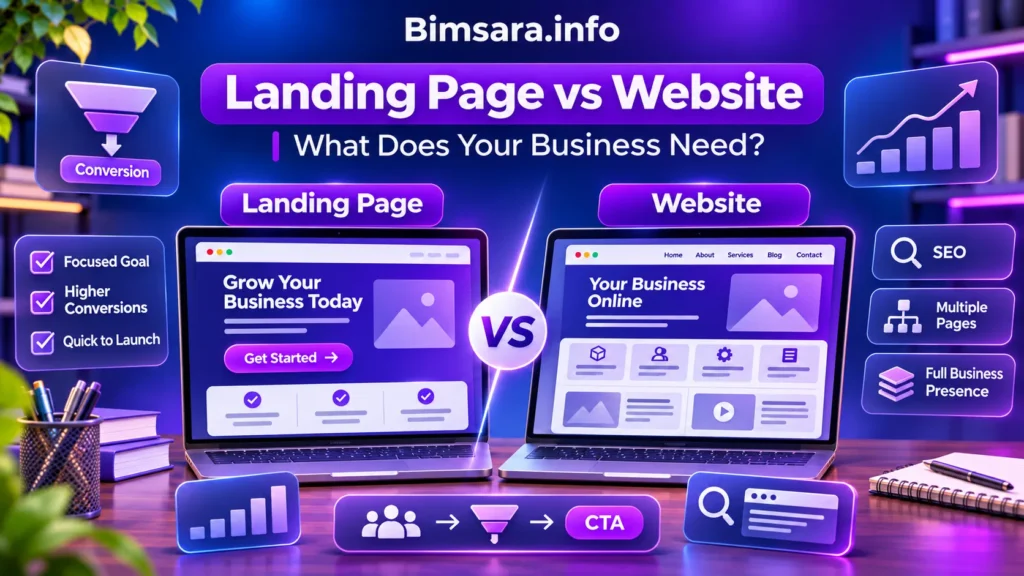
Landing page: focused message, one primary conversion goal, usually limited navigation, and content tailored to a specific offer or campaign. Full website: broader business information, multiple service or product sections, wider navigation, and a foundation for ongoing organic search and content.
1. When Should You Choose a Landing Page?
A landing page is a good starting point when you have one clear offer and a defined audience. For example, a Colombo-based training provider promoting a single upcoming workshop may need a page with the course outcomes, schedule, price, instructor information, testimonials and registration form. Sending campaign traffic directly to a long general home page may make it harder for visitors to find the relevant details.
Other suitable use cases include a limited-time promotion, a new product launch, a property viewing campaign, a consultation offer, an event registration page or a single service promoted through paid advertising. A landing page can also help a business test whether customers respond to a new offer before investing in a larger website.
Choose this route when the offer, target customer and desired action are narrow enough to explain clearly on one page. If visitors need to compare many services, understand a complex business or research your credibility in depth, a single page may not provide enough context.
2. When Does Your Business Need a Full Website?
A full website is usually more suitable when your business offers several services or product categories, needs to explain its experience and process, publishes educational content or wants to build a lasting presence in organic search. It provides dedicated pages for different customer questions instead of squeezing every topic into one long sales page.
A professional services firm might need separate pages for accounting, tax support, payroll and business advisory services. A retailer may need categories, product pages, delivery information, returns policies and customer support. A tourism business may need destination guides, tour options, booking information and frequently asked questions.
A website also gives customers a central place to verify your business details, view your work, read helpful information and contact you. Read our guide to why every small business in Sri Lanka needs a website and the essential features of a small business website.
3. Landing Page Design That Encourages Conversions
Start with one clear promise. The headline should reflect the visitor’s reason for arriving and explain the value of the offer in plain language. A supporting paragraph can clarify who the offer is for, what problem it solves and what happens next. Avoid vague claims such as ‘best service ever’ unless you can substantiate them.
Use one primary call to action (CTA), such as ‘Request a Quote’, ‘Book a Consultation’ or ‘Register for the Workshop’. Repeat it where appropriate on a longer page, but keep the action consistent. Tell visitors what happens after they click. If the CTA opens a form, make the form easy to find and complete.
Build trust with real business contact details, relevant examples of work, genuine customer reviews used with permission, transparent pricing or clear quotation steps, and accurate terms. Use original photographs where they help explain the product or service. Do not invent testimonials, customer logos, certifications or performance claims.
Keep the page easy to scan with meaningful headings, concise sections and enough spacing. Remove unrelated distractions, but do not hide essential navigation, contact information, privacy details or other information visitors need to make an informed decision. Google’s landing page guidance emphasizes relevance between the ad, keywords and destination page, clear calls to action, useful content and simple navigation.
4. Make the Conversion Journey Simple
A conversion is the action that matters to your business. It could be a submitted inquiry, phone call, WhatsApp conversation, appointment booking, email signup or completed purchase. Decide which action is most valuable before designing the page. Track secondary actions separately so that a button click is not mistaken for a completed sale.
Ask only for information you genuinely need at the first step. A quotation form might request a name, contact method, service required and a short project description. Additional questions can be asked during follow-up. On mobile, make fields comfortable to tap, use clear labels and explain errors in text so customers can correct them.
Match the page to the traffic source. If an advertisement promises a free consultation for a specific service, the landing page should clearly present that consultation and service rather than sending visitors to a generic home page. Make the next step obvious and test that the form, phone link, WhatsApp link or checkout works.
Use analytics or conversion tracking to measure completed forms, calls or purchases. Compare performance by traffic source and device. Test one meaningful change at a time, such as a clearer headline, a shorter form or a different CTA. A/B testing is most useful when there is enough relevant traffic to interpret the results; do not treat a small sample as proof.
5. SEO: Can a Landing Page Rank on Google?
Yes. A landing page can appear in organic search if it provides useful, relevant content and meets Google’s technical requirements. It should have a descriptive title, a clear main heading, a readable URL, useful page copy, relevant image alternatives and crawlable links where they help visitors. Google’s SEO Starter Guide recommends people-first content, clear organization and links that help users and search engines understand related pages.
However, a single landing page is not automatically a substitute for a complete website. If customers search for several different services, locations or detailed questions, one page may not satisfy all those needs. A full website can provide dedicated pages for distinct topics and build a useful content structure over time. More pages alone do not guarantee better rankings; each page should serve a real purpose.
For paid search, landing page relevance and usability matter to the visitor experience and Google Ads evaluation. For organic search, avoid duplicating near-identical pages for every keyword or location. Create specific pages only when you have genuinely useful, distinct information to provide. Our SEO basics for small business websites explains keyword research, on-page SEO and Search Console.
6. Mobile Design, Speed and Accessibility
Many campaign visitors arrive on a phone, so design the page for small screens first. Make the headline, offer, CTA and contact method easy to find. Use appropriately sized images, readable text and simple navigation. Test the page on real devices and slower connections, not just a high-speed office network.
Keep the page fast by compressing images, avoiding unnecessary scripts and using reliable hosting. Measure real performance and investigate issues rather than assuming that a visually simple page is automatically fast. Google also recommends useful, mobile-friendly landing experiences in its landing page performance guidance.
Make forms and controls accessible. Use visible labels, clear instructions, sufficient text contrast, keyboard-operable controls and understandable error messages. The WCAG 2.2 guidelines provide a useful reference, while the W3C’s web accessibility design tips explain practical approaches to navigation and forms.
7. How Much Does a Landing Page or Website Cost in Sri Lanka?
The budget depends on design quality, content preparation, page count, integrations, tracking, accessibility and ongoing support. Publicly advertised Sri Lankan examples reviewed on 20 November 2026 show how wide the scope can be: Nove-X lists a landing page from LKR 20,000; Dekode IT lists a landing page from LKR 40,000; and E Lanka Solution lists lead-capture, sales and premium landing page packages at LKR 40,000, LKR 60,000 and LKR 80,000 respectively.
These are examples of advertised starting prices, not an independently verified market average or like-for-like comparison. Package inclusions, revisions, copywriting, analytics, hosting, domain registration, integrations and maintenance can differ. Confirm current prices and deliverables directly with each provider. See the published examples from Nove-X, Dekode IT and E Lanka Solution.
A full website usually costs more when it includes multiple custom pages, content migration, a blog, multilingual content, booking tools, e-commerce, member accounts or third-party integrations. It may also require a larger content and photography budget. Our website cost guide for Sri Lanka explains the main factors that affect a business website quotation.
When comparing proposals, ask for separate prices for discovery and planning, design, development, content entry, domain and hosting, analytics setup, SEO foundations, revisions, training and post-launch support. Clarify who owns the domain, hosting account, design files and paid licenses. A low initial price may not include ongoing costs.
8. Which Option Is Better for Different Business Goals?
Choose a landing page if you are promoting one campaign, testing one offer, collecting leads for a specific service or need a focused destination for paid advertising. Choose a full website if you offer multiple services, rely on customer research and organic search, need detailed credibility information or plan to publish content regularly.
If you are unsure, consider a staged approach: launch a well-designed core website with the essential business information and one focused campaign page. Add dedicated service pages, resources or additional landing pages as you learn which customer journeys matter most. This avoids paying for features you do not yet need while keeping a path for growth.
Landing Page or Website: Decision Checklist
- Do you have one clearly defined offer and one main audience? A landing page may be enough to start.
- Do customers need to compare several services or product categories? Consider a full website.
- Will most visitors arrive from a specific advertisement or campaign? Build a matching landing page.
- Do you depend on people finding different services through Google? Plan a structured website with useful dedicated pages.
- Do customers need portfolios, policies, detailed FAQs or company information? Make room for those pages.
- Have you budgeted for content, tracking, hosting, maintenance and future updates as well as design?
Frequently Asked Questions
Is a landing page the same as a home page?
Not necessarily. A home page usually introduces the business and helps visitors explore the wider website. A landing page is designed around a particular audience, offer or action. A home page can function as a landing page for some traffic, but campaign-specific pages are often more focused.
Can I start with a landing page and add a website later?
Yes. You can start with a focused page on your business domain and expand the site as your services and content grow. Plan the domain, URL structure and content ownership so future expansion is straightforward.
Does a landing page guarantee more sales?
No. Results depend on the offer, audience, traffic quality, price, trust, competition and the customer experience. A landing page gives you a focused way to communicate and measure an offer, but it cannot guarantee conversions.
Do I need SEO on a landing page if I use paid ads?
You should still make the page useful, fast, mobile-friendly and accessible. Whether to invest in broader organic SEO depends on whether the page serves a distinct search need beyond the campaign. Paid traffic and organic search are different channels with different goals.
Need Help Choosing the Right Website for Your Business?
The right choice is the one that supports your current business goal without blocking future growth. A focused landing page can be a sensible first step for one offer, while a full website is better suited to businesses that need several services, resources and customer journeys.
Explore why a business website matters, learn how to choose the right web designer in Sri Lanka, or contact Bimsara.info to discuss your goals, required features and budget. We can help you scope a practical website or landing page project.
Editorial note: Public Sri Lankan package examples were reviewed on 20 November 2026. Advertised prices may change and should be reconfirmed with providers. Google and W3C resources linked above should be consulted for the latest technical guidance.